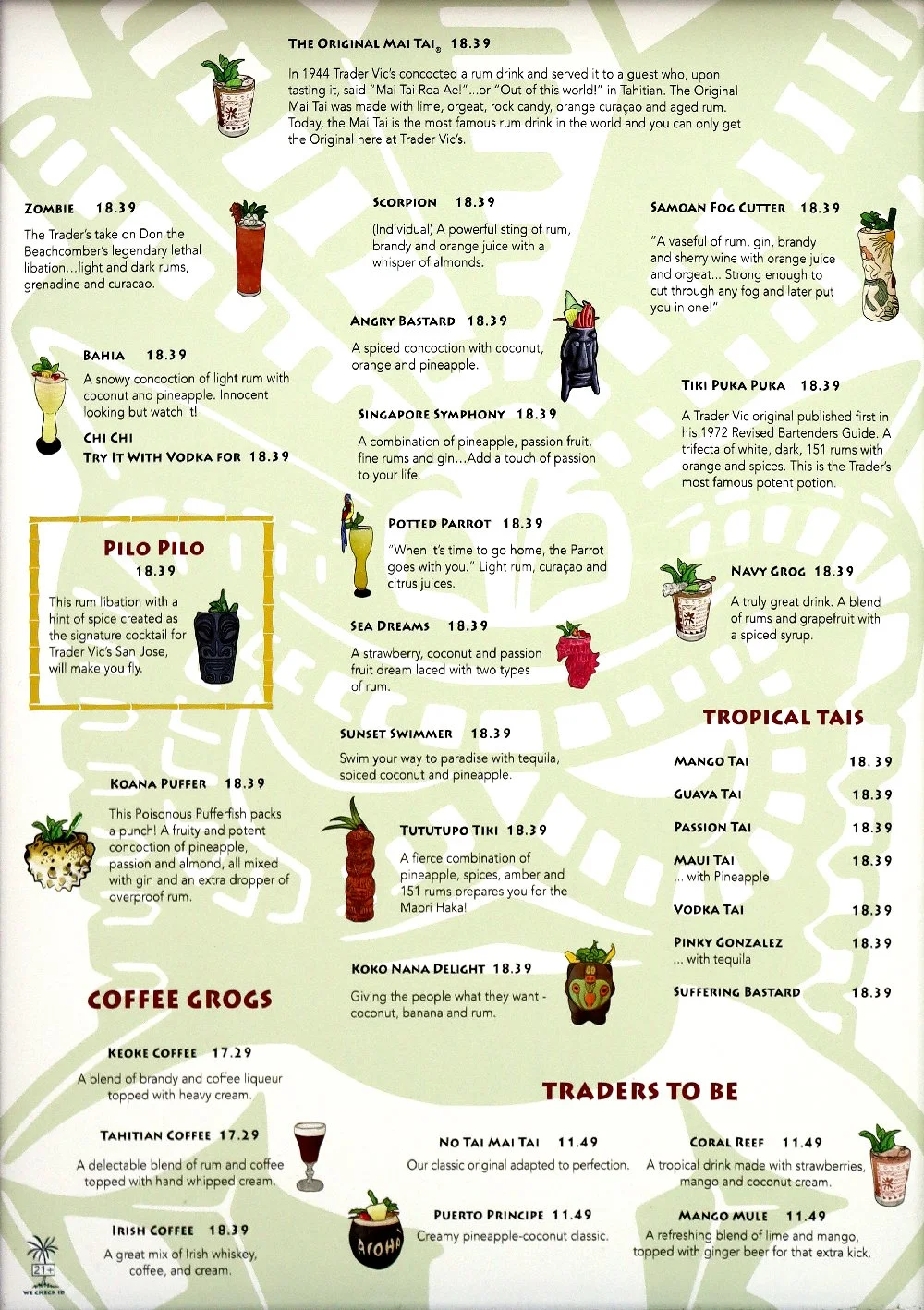
Themerica

Musings on Thematic Design and the End of Architecture

  • Blog
  • Archive
  • About

Polynesian Pop Vegas - Part 1: Frankie's Tiki Room.

July 03, 2026 by Dave Gottwald

It’s been five years since I’ve posted about Las Vegas. I last visited during the summer of 2022 for four nights, but that was purely for fun. So when I saw that this year’s University & College Designers Association (UCDA) Education Summit was in town this past May, I jumped at the chance to present. Because I was scheduled for four talks, the conference kept me busy for most of the week. So I decided to narrow my focus and take some deeper dives into the diverse types of theming that Vegas has to offer. One of them being the city’s tiki bars.

Tiki, or as it’s sometimes called by scholars, Polynesian Pop, was one of the themed topic areas of my MFA thesis, and I blogged about it in graduate school way back in 2008. Since then I’ve visited tiki bars all over the world, from Tokyo to Dubai, but by far most of my stops have been in the United States.

Vintage postcard, Aku Aku.

Early Vegas Tiki and the Aku Aku

Sin City’s most famous historical Polynesian restaurant was the Aku Aku at the Stardust Casino and Hotel (1960–1980) that was named for Thor Heyerdahl’s 1957 book Aku-Aku: The Secret of Easter Island. Heyerdahl was a Norwegian zoologist and ethnographer whose stories of South Seas research in The Kon-Tiki Expedition (1948) gave birth to the popular use of the word “tiki.” Several bars and restaurants bearing the Kon Tiki name flourished during the 1950s and 1960s. So it was with Aku Aku.

Vintage postcard, Bali Hai.

South Seas theming had appeared like an oasis in the Nevada desert a bit earlier with the 1957 openings of the Bali Hai, a budget-friendly, drive-up motel, and the Tropicana Hotel and Casino. But Bali Hai lacked a restaurant and the Tropicana was more broadly, well, tropical in orientation, calling itself “The Tiffany of the Strip” with much attention focused on the Folies Bergere Paris showgirl revue.

Vintage advertisement for the recently opened Aku Aku, 1960.

When Aku Aku arrived three years later at the Stardust, it thus billed itself as the Polynesian dining trend so popular in Southern California just now arriving. AT LONG LAST! — in LAS VEGAS!

Eli Hedley working on one of his giant Moai carvings.

Aku Aku (which reportedly originally seated seven hundred guests and was staffed with a twelve cooks and two dozen servers) actually had a direct connection to theming’s family tree. Some of its exterior statuary and decor were provided by Weldon “Eli” Hedley (1903–1981), a man known as the Original Beachcomber. Hedley had performed similar services for other South Seas establishments in Southern California as well as the famous Lake Tahoe Polynesian restaurants Trader Dick’s and Harvey’s.

1969 Aku Aku menu cover featuring Hedley’s Moai as the primary icon. Courtesy Los Angeles Public Library.

He was specifically tapped to carve the fifteen-foot black rock Moai (Easter Island) statuary out front, one of which has survived at Sunset Park in southeast Las Vegas on an island at its duck pond.

One of Eli Hedley’s three retail stands in Adventureland.

According to the Van Eaton Galleries auction catalog for The Story of Disneyland (2015), Walt Disney had personally hired Hedley to add theming to Adventureland and let him have a concession in the park known as Tiki’s Tropical Traders and later The Island Trade Store:

In exchange for carving early Adventureland tikis and offering general scenic decor, Hedley was given the shop space rent free. Walt negotiated the lucrative arrangement personally. The fine tradition of offering rubber snakes, glowing skulls and shrunken heads to young adventurers continues to this day in approximately the same location as [the] 1950s original.

Another of them right next door to the Jungle Cruise.

Prolific Disney parks researcher and writer David Koenig clarifies further in The 55ers: The Pioneers Who Settled Disneyland (2019) that Hedley actually had more than one concession within Adventureland:

Walt hired him to carve a towering tiki for just inside the entrance to Adventureland. Hedley soon found himself operating two spaces inside the Bazaar, one selling tropical trinkets such as tiny tikis, the other selling island-themed jewelry. He later expanded to a third space in the Bazaar.

When asked to provide carving work for the Aku Aku, the story goes that Walt Disney agreed as long as he kept crafting pieces for Adventureland on a farm property across from the park on Katella Avenue and manning his concessions during the day, at night he was free to take on the Stardust contract. From the pages of Liquid Vacation (2013):

Because of the deal with Disney, the sculpting of these monoliths presnted the unique problem of getting the raw materials to a place where Hedley could work on them. The problem was solved when the Stardust commissioned the mining of three thirty-foot blocks of volcanic featherstone from a quarry in northern Nevada and had them delivered to the farm. The finished Moai statues were then shipped to Las Vegas.

So yes, the Aku Aku’s statuary was crafted across the street from Disneyland after hours by a man who helped decorate Adventureland for Walt.

Vintage postcard, Aku Aku.

The restaurant’s bar, known as the Aku Aku Room, served a cocktail menu created by another famed bar owner of Polynesian Pop, Donn Beach (1907–1989), founder of the Don the Beachcomber franchise. Though the Grand Opening was quickly marred by a kitchen fire that destroyed its interior, Beach continued to consult on its rebuild. He once claimed that he was paid for his services by the mobsters who ran the Stardust with two brown paper bags each filled with $50,000 cash (that’s over one million dollars today).

The Aku Aku featured native carvings and some tiki modernesque interior design work by Hawaiian artisan Edward “Mick” Brownlee (1929–2013), perhaps at the recommendation of Beach, with whom he had worked before. Along with strand upon strand of glass Japanese fishing floats arranged like abstract curtains.

1969 Aku Aku menu back page. Courtesy Los Angeles Public Library.

In a declaration common at the time, at the back of the Aku Aku’s menu the establishment boasted how authentic its food and decor was, specifically mentioning Brownlee “of the Honolulu Art Academy, an authority on Melanesian, Micronesian and Polynesian artifacts.” Brownlee, of course, was white, a native of Portland, Oregon.

Aku AKu menu cover from the early sixties.

However “authentic” mid-century Polynesian Pop restaurants and bars claimed to be, the fact is that this design aesthetic was pointedly a middle class, suburban phenomenon completely detached from the actual native cultures of the South Seas. Even when dressed in foreign garb, as with the man in the turban on the menu cover above, the persons depicted were always caucasian.

1969 Aku Aku menu inside cover. Courtesy Los Angeles Public Library.

That is, except for native girls, which often had darker skin to emphasize and eroticize their supposed exotic looks.

Click for the clip on YouTube.

The establishment was iconic enough to be briefly re-created (quite inaccurately) inside The Riviera for a scene in the Martin Scorsese film Casino (1995).

Aku Aku interior entrance, circa 1974. Courtesy UNLV Special Collections and Archives.

The actual interior entrance from the casino floor was a broad railed ramp flanked by two large carved tikis, neither of which were Moai. And although there was a backlit sign above the threshold featuring a single graphic of one, there was no green neon.

The exterior entry from the parking lot was even more outlandish, following the A-frame Polynesian supper club and bar design conventions of the time. Notice Eli Hedley’s large Moai carvings to the left and right.

The one at the parking lot’s edge, however, was massive. More than a couple stories tall. The 1969 photograph on the right is from a 2000s Stardust room key and it really shows the scale of this Moai carving.

Don the Beachcomber, early sixties. Courtesy UNLV Special Collections and Archives.

The popularity of the Aku Aku set off a tiki boom of sorts. In 1962, Don Beach opened a franchise location at the Sahara Hotel and Casino.

The Castaways, late sixties. Courtesy UNLV Special Collections and Archives.

Then a year later the Sans Souci Hotel, which opened in 1955, was re-themed as The Castaways, and remained the longest Polynesian Pop presence on The Strip until 1987 when it was demolished to make way for the Mirage.

Family dinner at the Aku Aku, 1973.

For me the Aku Aku’s most historic and charming aspect is that while dating and pondering engagement, my mother and father dined there on May 4, 1973 with my father’s parents. You can see my grandmother’s drained mai tai glass along with a couple empty daiquiris and devoured baby Hawaiian barbecued spare ribs on the table in the foreground. In seven short years the bar and restaurant would be no more.

1969 Aku Aku menu. Courtesy Los Angeles Public Library.

Here you can see the appetizer or “pu-pu” list they ordered from. Pu pu is indeed a Hawaiian word which means hors dʻoeuvres. I can’t say what they cost when my parents dined there, but based on the 1969 price quoted about, those spareribs [sic] would set you back nearly $27 today.

Where my parents likely sat (window portal highlighted with stroke).

I’ve tried to ascertain where my parents were sitting for their meal, but it appears to be behind one of these rectangular portals. All of the photographs I’ve been able to locate are from the 1960s, and I’m not sure how much remodeling had been done by 1973.

Entrance to Taboo Cove, the Venetian Resort and Casino

Attempts at a Revival

Tiki would not return to the Las Vegas Strip until 2001 with the opening of Taboo Cove at the Venetian Resort and Casino. The first new properly themed tiki bar to open in the United States since the early 1970s, Taboo Cove was designed and decorated by famed Polynesian Pop artist “Tiki Bosko” Hrnjak. Sadly it was shuttered by late 2004 and reopened de-tikified. Taboo Cove’s downfall was due to a poor location deep within a casino with a completely different theme, inadequate promotion, and blaring club music, which drove more authentic fans away.

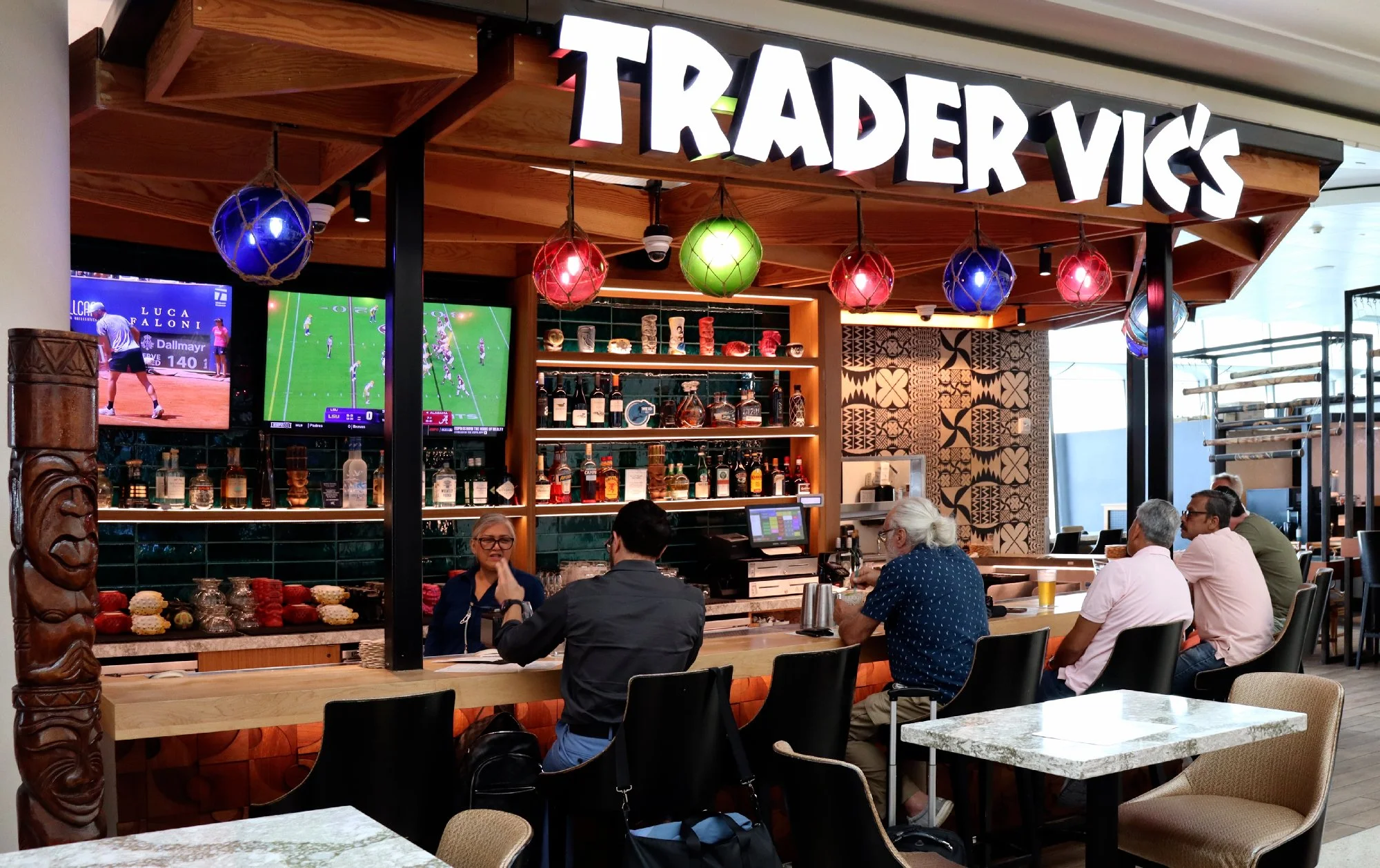
The bar at Las Vegas Trader Vic’s, 2008.

Next was a Trader Vic’s location in the Miracle Mile shops at Planet Hollywood Resort & Casino. When I visited during the summer of 2008 it had not yet been opened a year. Apart from some large carvings and stylized graphics like this backlit mask behind the bar, the space was basically unthemed and was aimed at the vodka Red Bull crowd rather than actually Polynesian Pop aficionados. In 2009 Vic’s met the same fate as Taboo Cove, as much a victim of the economic downturn as its poor design.

Frankie's Tiki Room

Las Vegas is currently undergoing a tiki bar revival, however, that began with the opening of a new bar closer to downtown Las Vegas roughly six months before Trader Vic’s on the Strip folded, Frankie’s Tiki Room.

If the neon signage outside this white stucco stand-alone building looks like classic Vegas, it’s because it is. Liquid Vacation: 77 Refreshing Tropical Drinks from Frankie’s Tiki Room in Las Vegas (2013; reprinted 2024) notes that Frankie’s Bar and Cocktail Lounge had been around since the 1950s before falling into disrepair and being put up for sale. What inspired the owners of the punk rock Double Down Saloon, P Moss and his partner Chris Andrasfay, to buy it and turn it into a tiki bar was the loss of Taboo Cove. The redesigned Frankie’s opened on December 4, 2008.

The signage was kept and fitted with new graphics, keeping the original moniker in tribute to the good ol’ days of this local watering hole. From Liquid Vacation:

Some swear the bar was named after Sinatra. Not true. Some say it was named after the wife of the original owner. Maybe. But whatever the origin, and despite the fact that most tiki bars have Polynesian-sounding names, rebranding the new concept was never considered and the name Frankie’s was kept out of respect for a historic Las Vegas so many others are too quick to implode.

The marquee above routinely features humorous phrases, like FORGET ROSES BUY HER A MAI TAI or KNOCK BACK A VICIOUS VIRGIN / BE THE FIRST. My favorite is their Christmas greeting: GET A HEAD START ON HOLIDAY DRINKING.

The new lettering is typical of mid-century advertising and jumbles along the baseline as if dancing the conga.

The entrance is a mix of Polynesian Pop iconography and a playful illustration style that suggests tattoo art. The red door looks like a dive bar. This could easily be a biker hangout or a punk rock venue, and that’s part of Frankie’s charming-yet-sleazy exterior vibes. More downtown Las Vegas than the Strip. It feels like a local joint.

Printed along the backlit arch above are the words KAHI MALUHIA LOA I KA HONUA in the same funky typeface as the other FRANKIE’S and GAMBLING signs.

The phrase translates from Hawaiian as “The Most Peaceful Place in the World.”

Every traditional tiki establishment, like the Aku Aku, was typically guarded by statuary at the entrance, and Frankie’s is no different. These sit at either side of the front door. You can also see part of the vivid lowbrow mural to the right which wraps the entire ceiling of the arched entry.

Another more elaborate and unique carving sits off to one side by a bike rack.

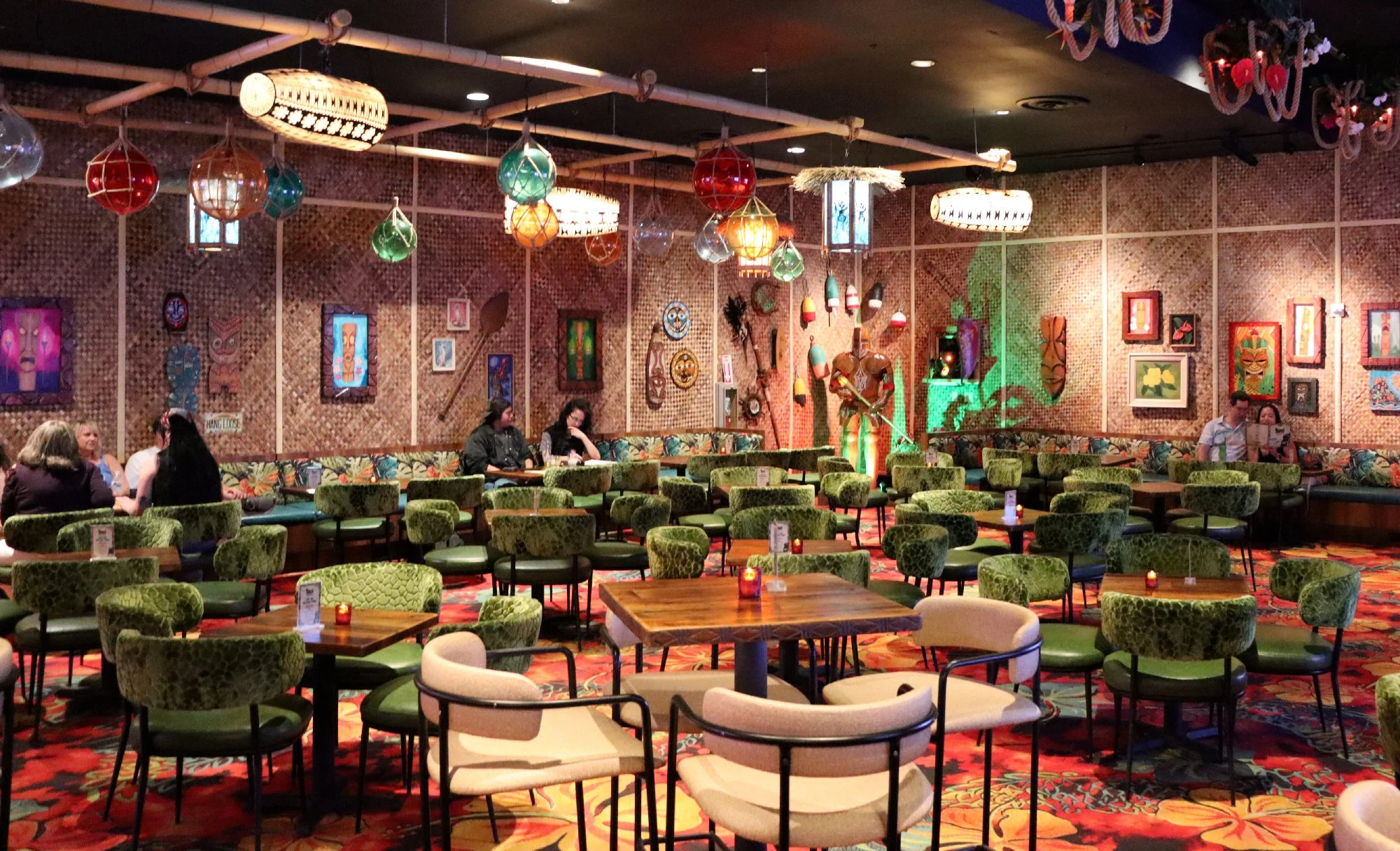
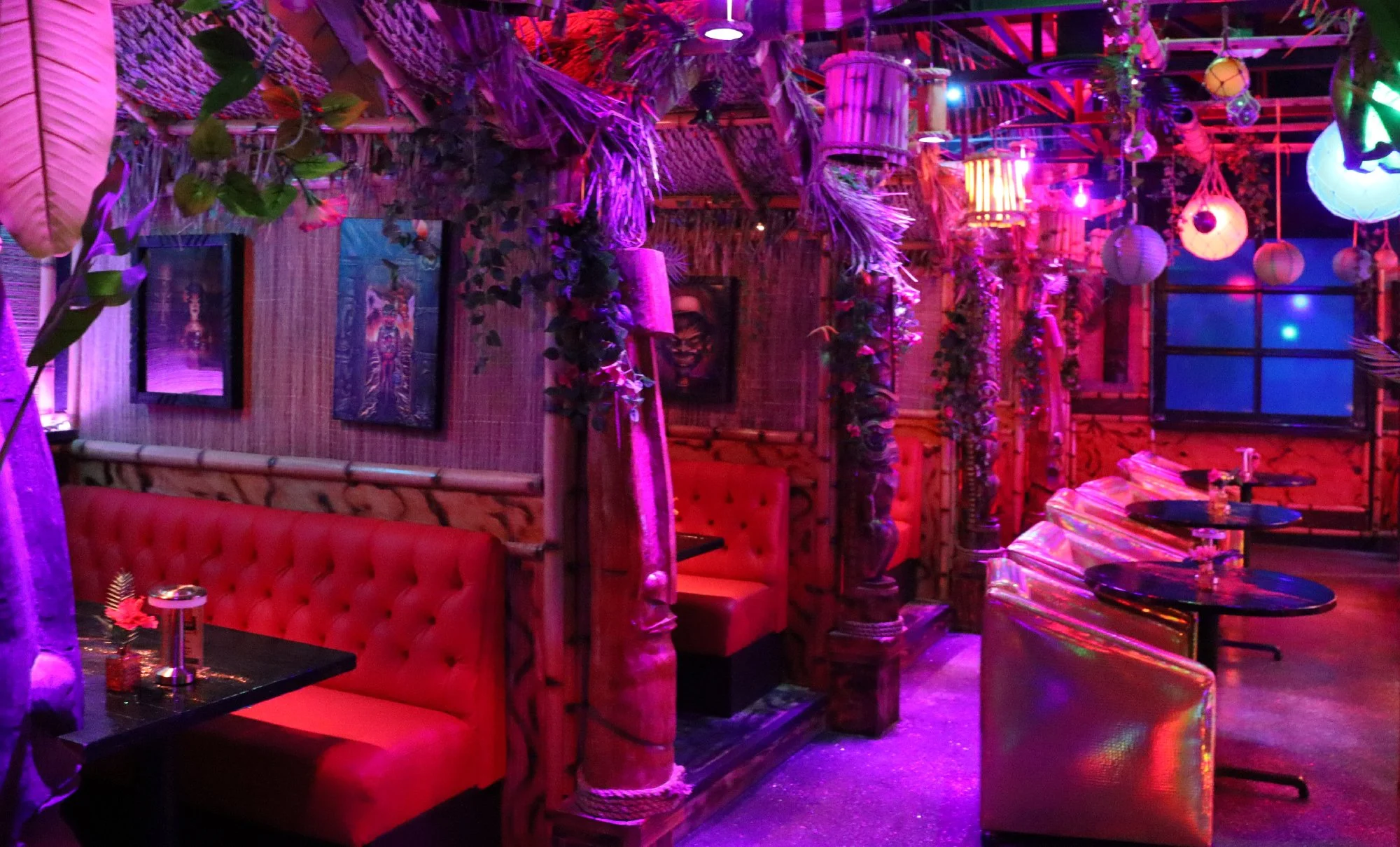
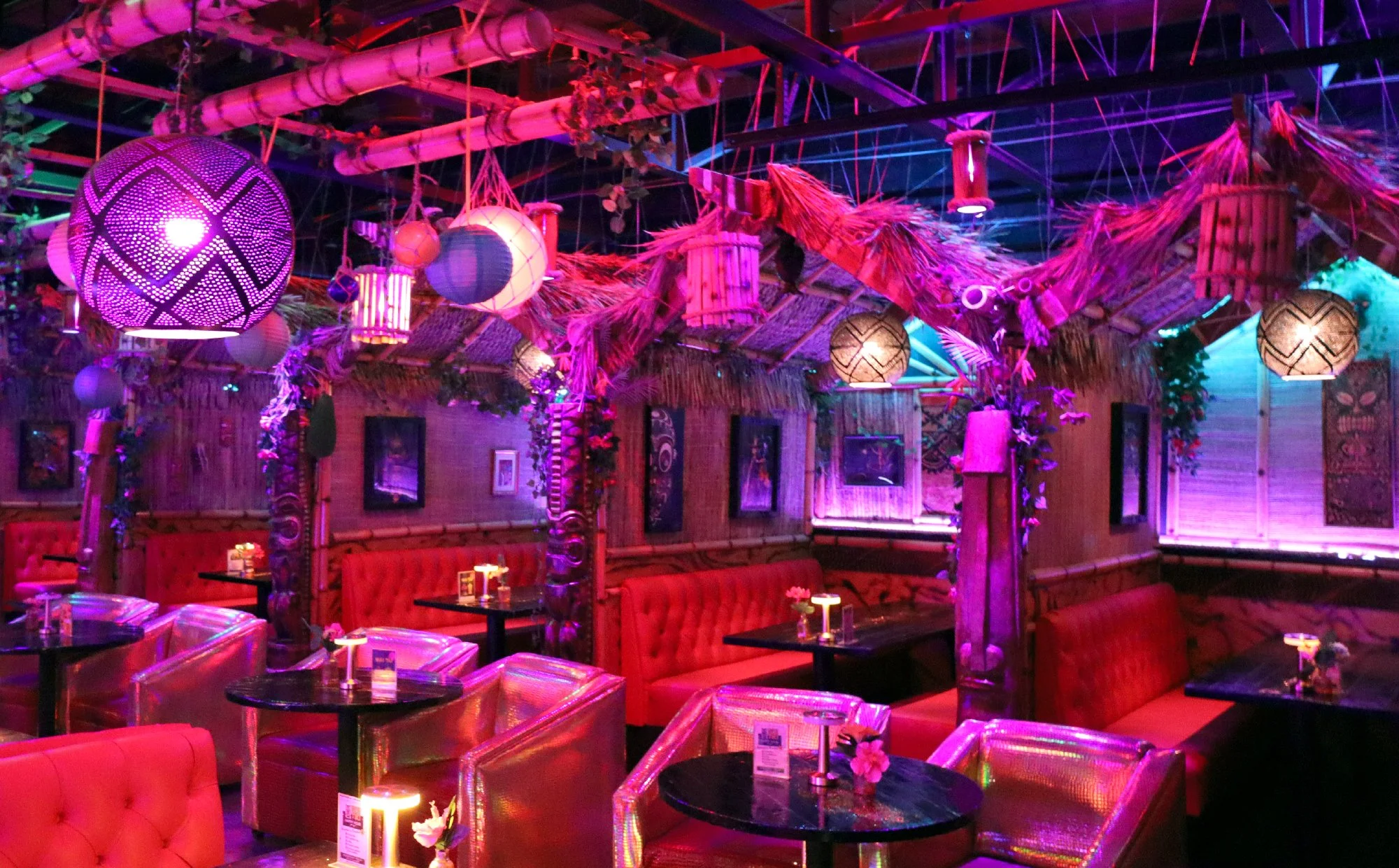
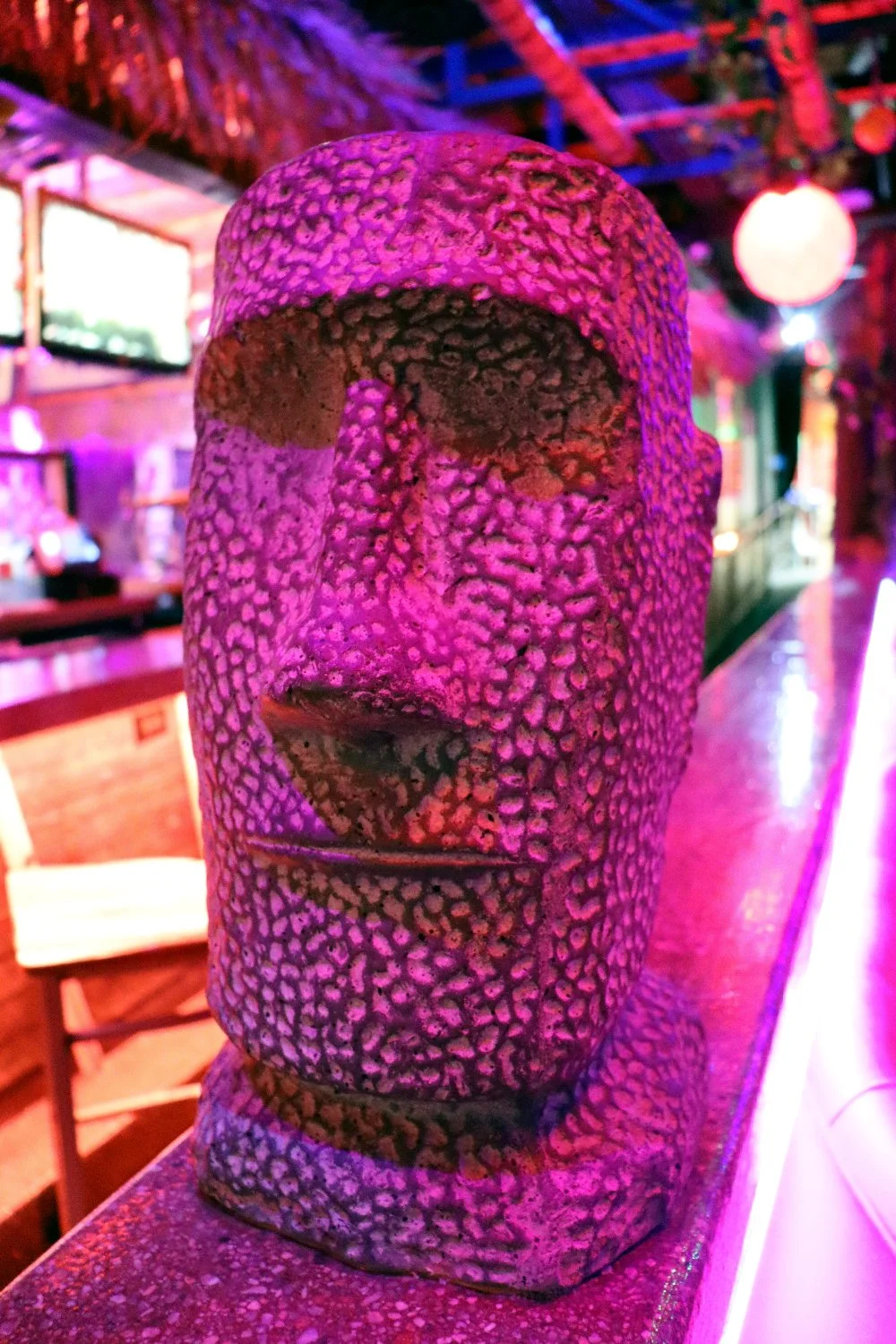
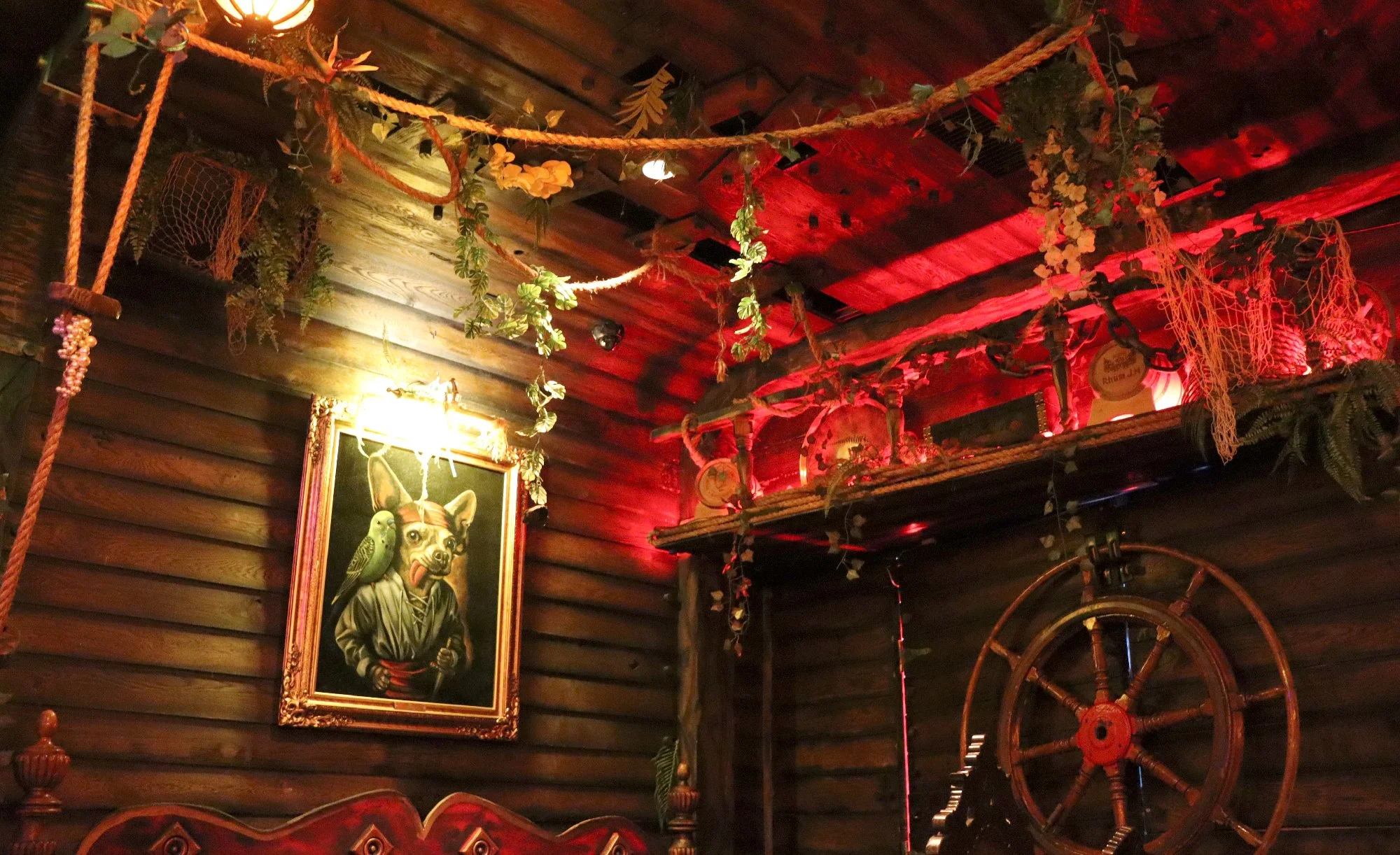
Walking in, you find a very, very dark bar. In fact it was difficult to take photos without a flash. But the decor is lush and recalls the classic tiki bars of the past.

Why all this talk of the Aku Aku before getting to Frankie’s? Well, because the interior was designed by none other than the grandson of Eli Hedley, noted carver and decorator “Bamboo Ben” Bassham. Ben has since gone on to design other tiki projects in Vegas, including one currently underway. Here’s a great 2015 interview with him.

Part of the charm of Frankie’s, which I’ve visited several times over the years, is that it splits the difference between themed immersion and what is clearly a typical Las Vegas cocktail lounge which can be found inside any casino.

To wit: Frankie’s is open twenty-four hours a day, seven days a week (a first for tiki). The bar is lined with video poker machines. You can smoke inside. So even though you can take your drink and wander over to one of the thatch-roofed seating areas, replete with Polynesian decor, it’s impossible to forget that you’re in Vegas. Frankie’s looks like it, sounds like it, and even smells like it, despite its tiki makeover.

Indeed there are moments where you can see the Frankie’s of the 1950s in the black ceiling poking through the thatch overhead.

However, they don’t call him Bamboo Ben for nothing. Every wall of Frankie’s is covered with it, along with many carvings and hand-crafted furniture, some of it provided by Tiki Bosko who had done the same for Taboo Cove.

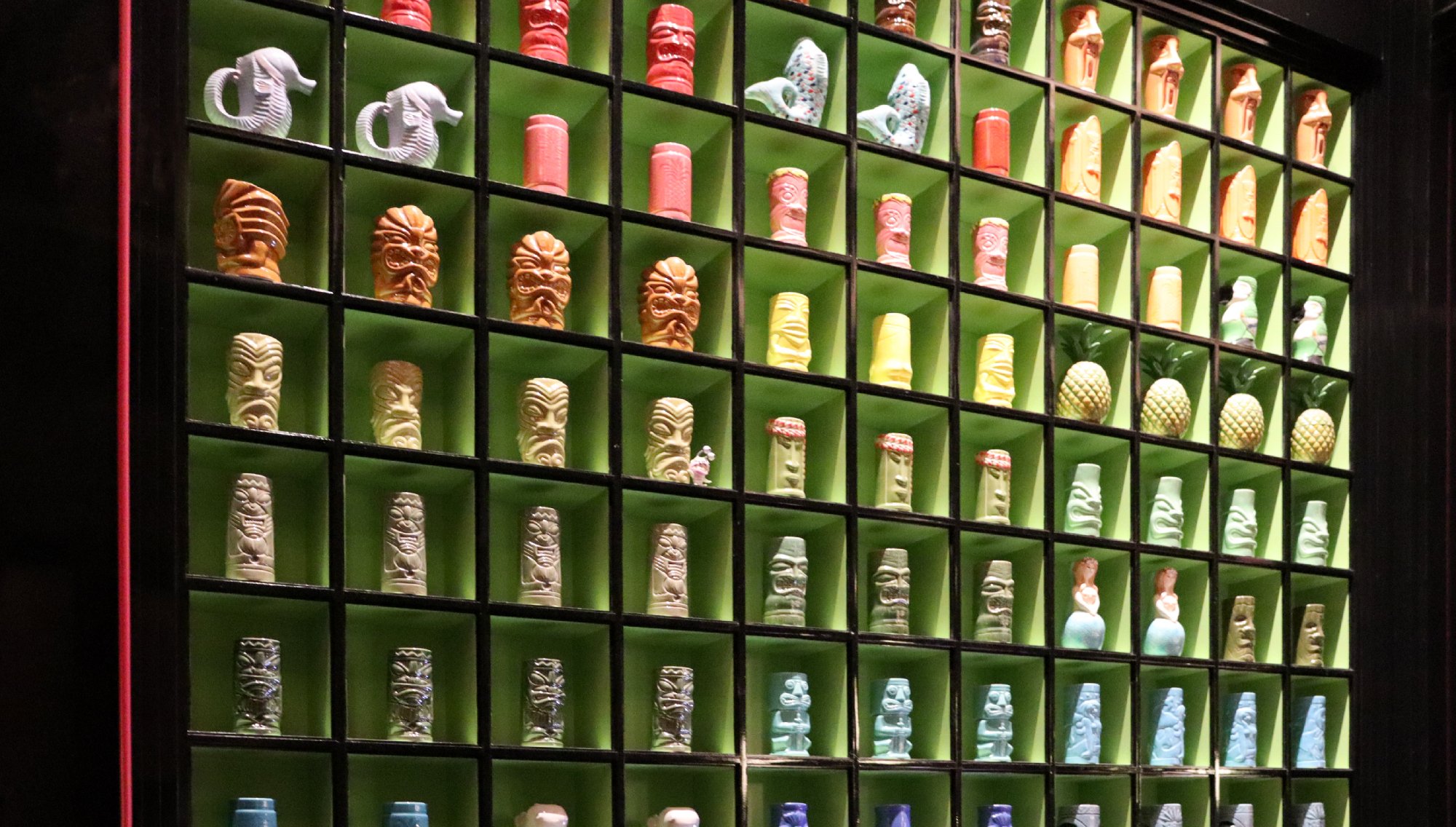
Lowbrow artists were also commissioned to provide many paintings and tiki mug designs. This one above is typical of the lowbrow style and mixes pop icons like the Creature from the Black Lagoon (1954) with Bamboo Ben himself drinking alongside several characters that appear in Beetlejuice (1988).

Frankie’s successfully walks the line between the twenty-four hour video poker and indoor smoking Las Vegas is famous for, along with stirring in punk rock, biker bar, and lowbrow art with traditional tiki bar decor, drinks, and souvenir mugs. It’s a local favorite and also a must-see for Polynesian Pop enthusiasts visiting town.

Continued in Part 2.

July 03, 2026 /Dave Gottwald

Kingdoms of Artifice is Available for Pre-Order.

May 21, 2026 by Dave Gottwald

Finally, my monograph project with Dr. Benjamin George of Utah State University, Kingdoms of Artifice, is now available for pre-order. Well, it’s been available for over a month now, but I’m just getting around to posting about it.

I’ve mentioned him before, but my friend Benjamin is Associate Professor in the Department of Landscape Architecture and Environmental Planning at Utah State University, where he teaches courses in landscape architecture. George's research interests include the impact of technology on design processes, zoo design, online design pedagogy, and landscape history. He is the creator of the award-winning Digital Library of Landscape Architecture History.

To remind, The opening of Disney’s Animal Kingdom (1998) introduced the design principles of the theme park to the display of wildlife. In the decades since, zoo designers the world over have adapted Disney’s approach in theming both the visitor and the animal experience.

With Kingdoms of Artifice we critically examine how post-Disney zoo environments combine entertainment with education and complexify authenticity with theatricality.

Both of us are thrilled with the blurbs provided by the reviewers…

“This volume brilliantly situates the contemporary zoo within the broader world of themed environments, showing how narrative, design, and immersion reshape our encounters with animals and nature. It is both intellectually engaging and highly relevant, offering fresh insights into the cultural work that zoos perform in the twenty-first century.” —Scott A. Lukas, Lake Tahoe Community College, USA and author of Theme Park (2008)

“Engaging and highly accessible in tone, this book is essential reading for anyone serious about understanding the evolution of the modern zoo and Disney’s transformative contribution to it, enriched throughout with insights and reflections from many of the leading figures in zoo and attractions design.” —Bernard Harrison, Former Singapore Zoo Director and Internationally Renowned Zoologist, Indonesia

“I've known Dave Gottwald for the last thirty years and it came as no surprise, having known how unique a perspective he viewed all of life, that he would come up with an idea this fresh, insightful, unique and for me out of left-field. I know nothing about the subject matter, and thus, was just amazed with not only the originality of this concept but how extraordinarily well it was researched. I always tell people they have adult jobs because all I do is draw Mickey Mouse all day and this is a perfect example – an adult with an extraordinarily original concept that I never would've thought of. Enjoy!” ―George Scribner, Artist and Animator, Walt Disney Imagineering, Panama, and Director of Walt Disney Animation Studios’ Oliver & Company (1988)

The ebook PDF and hardcover are now available for pre-order from Bloomsbury Academic, Studies in Disney and Culture, and will be released September 3 and October 1, 2026, respectively. I’m quite pleased with this date because it’s the beginning of Disney’s fiscal year. Both the Magic Kingdom (1971) and EPCOT Center (1982) opened on October the first.

It’s pretty funny that Benjamin first met me because of an Amazon review I wrote. And now we have our very own page. We’ve also started a zoo and theming research blog so be sure to check it out.

May 21, 2026 /Dave Gottwald

The Typography of Disney's Animal Kingdom Part 3: DinoLand, U.S.A.

February 01, 2026 by Dave Gottwald

DinoLand, U.S.A. is going the way of its subject. Extinct. As the park’s original lead creative Joe Rohde lamented on Instagram, today, February 1, 2026, is the last day to experience this part of Disney’s Animal Kingdom (DAK).

Back in August 2024, Disney announced the area will be replaced with an equatorial part of the globe not yet represented at DAK, Central and South America:

Tropical Americas — better known as Pueblo Esperanza — will be a new 11-acre lush and sprawling area. Just like Harambe, this land will feel lived in, with a long, rich history.

Along with appropriate vegetation, characters from Disney’s 2021 animated film Encanto will be moving into Tropical Americas along with jungle adventurer Indiana Jones.

This portion of DAK was jokey and light, the only part of the park’s original design which oozed “cute.” It was Michael Eisner’s idea for a kids area. Despite the rest of DAK’s emphasis on realism, he reportedly told Rohde’s team to “lead with your clichés,” and simply name the dinoland, well, DinoLand.

Rohde says the intent was hokey, “part wacky souvenir stand and part dinosaur dig.” He reasons that “ultimately not everything at Animal Kingdom could be this gigantic labor-intensive landscape exercise. We needed that kind of theme-parky land,” he thought, especially for younger children.

Still, the land carried Animal Kingdom’s overall values. In our interviews with him, Rohde reminded us that dinosaurs, as adorable as kids may find them, require a very cerebral, adult form of affection to truly appreciate. Dinosaurs represent a mature love of wild creatures, manifested as “the intellectual study of the animals, the science of the animals.” Rohde observes that dinosaurs “exist literally as minerals, as fossils. It is only through human intellectual exercise that they become animals again.”

This messaging within DinoLand, U.S.A., however, was at times subtle. As Rohde noted in his Instagram post:

I will never know how many people picked up on the Venn diagram of ideas in play. The old school professors defending outmoded ideas. The young students with challenging new theories. The corporate financiers and their amoral profit motive. The roadside America entrepreneurs and their simple non-academic love of dinosaurs for pure fun.

Here in tribute is a look at the land’s unique lettering styles.

The aesthetic of DinoLand was that of mid-century roadside Americana. Typographically, it’s a lovely treat. The above billboard, for example, employs dimensional text like so many early 20th century tourist WELCOME TO… postcards.

Apart from some standard amusement park-style rides within Chester & Hester’s Dino-Rama!, a playful interpretation of Route 66 roadside camp and whimsy, the other big attraction was The Boneyard, a playground themed to a paleontological fossil dig where the graduate students had set up camp.

Leveraging design empathy, the Imagineers designed it as a child’s look at a working paleontological site where skeletons have become slides, jungle gyms, and frameworks for swings. With these embedded didactics and other similar flourishes, DinoLand, U.S.A. demonstrated the best of quality children’s zoos, where learning goes hand in hand with fun. All of the notes appear to be actual handwriting, not digital fonts.

The Dino Institute building, themed as a contemporary natural history museum, housed the land’s thrill ride, Dinosaur. The billboard / mural out front featured some hand-painted Copperplate along with Brush Script, which was designed by Robert E. Smith for American Type Founders in 1942 and quickly became ubiquitous in mid century advertising.

The seal of the institute was rendered in a bold geometric sans-serif with a curious condensed weight wrapping the lower half.

Later this year, Dinosaur—originally called Countdown to Extinction—will begin a reversion to its technological origins to be reborn as an Indiana Jones attraction similar to Disneyland’s. As the ride’s footprint had always been a clone of that attraction, this is a an obvious and cost-effective move on the part of the Imagineers.

Surrounding the Dino Institute, which represents our scientific relationship to extinct species with its fairly direct signage, was carnival-like hucksterism. According to Alex Wright’s The Imagineering Field Guide to Disney's Animal Kingdom (2007), this “crass commercialization of dinosaurs” around this small stop in the American Southwest stood in contrast to the paleontological site.

Because of the fossils discovered nearby, the residents were trying to capitalize on it. Venues included Chester & Hester’s Dinosaur Treasures, a curio shop, and the Restaurantosaurus, a fast food outlet.

Some bristled at part of Animal Kingdom being set so close to home and portrayed so comically. For Rohde, however, DinoLand, U.S.A. was just as realistic a depiction of a human-animal relationship as anything else at the park. As he told Tales from the Laughing Place magazine, “[This] is part of roadside America. Most Americans need to drive cross-country to see dinosaurs and invariably it means pulling off of the freeway and either looking at fossils and rocks…a dig site and a rock shop. This is our experience of dinosaurs.”

The hand-assembled lettering above, made of pre-fabricated characters seemingly bought at a hardware store, along with the Christmas tree lights, fit this vibe perfectly.

Amateur signage was everywhere in DinoLand, much of it sporting the groan-inducing puns that the Imagineers are known for.

But there were also more professionally rendered moments, all of them consistent with the mid century setting. To the trained graphic design eye, these typefaces are clearly contemporary revivals. In fact, they look like typical offerings from the Font Diner digital foundry, which launched in 1996, when DinoLand would have been in development. But to the average guest, every sign harmonized with what we’ve been taught of the past from television shows and the movies. Feeling authentic is what matters.

Small moments, like this popcorn lighted arrow sign, appeared authentic to anyone who has stopped on the highway in the middle of the desert to relieve themselves at a filling station.

This was perhaps one of my favorite billboards in all of DinoLand. There is something about the imperfect dimensional type and the irregular “GOOD BUY” capitals that rang true with the vernacular signage as captured by graphic designer and educator Ed Fella on his countless American roadtrips documenting amatuer lettering.

There were countless sight gags throughout DinoLand, U.S.A. This one hinted at one explanation for the mass extinction event that wiped out these creatures—a comet.

The story graphics around The Boneyard area, in the form of signs and notices tacked up, represented a lively scholarly debate in language accessible to younger guests. Here we find Brush Script again as well as long passages set in Cooper Black, a mainstay of the 1930s which saw broad revival in the 1960s.

The cast members here were trained as docents by the DAK conservation and science team to interact with kids at their level. All the pinned up graphic ephemera reinforced this.

Though I never spent much time inside DinoLand, U.S.A. on my visits to Animal Kingdom, I do feel that the area was somewhat unique and held a particular charm, not just for younger visitors but—like so many lands at the Disney parks—for also the young at heart.

In a way, it was DAK’s Fantasyland, and I’m sorry to see it go. Still, at the same time DinoLand was always an odd fit, and introducing the only equatorial zone not yet represented at the park along with regionally appropriate IP makes total sense.

Farewell, DinoLand, U.S.A.

February 01, 2026 /Dave Gottwald

The Typography of Disney's Animal Kingdom Part 2: Asia.

August 02, 2025 by Dave Gottwald

Asia at Disney’s Animal Kingdom on the eastern edge of the park was not ready by April 1998. This was all part of the plan. Creative lead Joe Rohde reminded us that the project budget was fleshed out as a series of successive capital allocations. “In order to get the money to build the park at all,” his team had to focus on the entry, center, Africa, and DinoLand, U.S.A., Rohde explains. “Everything else was added in fragments,” and the Asia expansion was finally authorized “out of the recognition that we were just going to need more ride capacity.”

Crossing the entry bridge from Discovery Island made of red brick and white stone pedestals, inspired by Nepalese temples, there is a large marquee above that spells ASIA in an Indian-like script typeface that can be read as English.

It was decided to push out most of Asia into 1999, but on opening day there were visual hints of what was to come, including a 1,250-seat outdoor theater called the Caravan Stage. The design of the ancient-walled space is a caravansary, where travellers gather there wagons to rest as a kind of ac hoc hostel. Here the entrance story graphic is elaborately embroidered in a Middle Eastern tapestry.

The Caravan Stage originally housed Flights of Wonder, an exotic trained bird performance common at many zoos. This story graphic banner is presented in-world as if this is an actual traveling show put on by locals.

I think Joe Rohde’s Imagineering team outdid themselves with Asia. The graphic design is even more elaborate than what’s found in Africa. Here ghost graphics, story graphics, and operational wayfinding are seamlessly blended together in a single environmental gestalt.

Anandapur

The Asia equivalent of Harambe in Africa is the fictional town of Anandapur, which means Place of All Delight in Sanskrit. Anandapur the town sits within the Kingdom of Anandapur, a fictional nation state “somewhat like India, somewhat like Nepal,” Joe Rohde says, yet “somewhat like Indonesia [and] Bhutan.”

In many places, Indian English is accompanied by Sanskrit script, which Joe Rohde says was a conscious choice. Though the designers “didn't continue with this because it was very, very difficult,” he told us the Imagineers “made almost all the original signage in old Sanskrit, which isn’t Hindi,” he reminds. “So that even a person from India reading a sign would have that sense of, ‘oh, that’s not where I’m from.’”

Snacks and beverages are available at Drinkwallah as sponsored by Coca-Cola. Note the fictional proprietor—Rohana Burhan. This is a common Imagineering backstory technique. The hand lettering is charming and the sign is realistically distressed and faded.

The Coca-Cola FROZEN DRINKS lettering is typical of the company’s branding, a concession that must often be made for Disney park sponsors. Yet the aging of the metal sign as well as the fitted pipe supports fit with the setting.

India’s version of the company’s classic red and white script logo is also hand-painted on one of the stone brick walls of Drinkwallah.

Inside Drinkwallah there is more signage based on those found in India as well as authentic glass Coke bottle props.

Regrettably, in one of Animal Kingdom’s few design snafus, the sign here for Mandala Gifts has been rendered in Ondine, an Arabesque calligraphy script designed by Adrian Frutiger in 1954 that would never have been used in India. Ondine is an exotic-looking font to Western eyes and is common at lesser zoos and amusement parks (along with any kind of ethnic restaurant you can think of, from Chinese and Middle Eastern to Thai and even Greek).

Again at the bottom is an authentic-looking Indian Coca-Cola sign.

Joffrey’s Coffee & Tea Company is a real Tampa-based chain. Though its name and logo are reproduced inside this beverage stand, the company has also undergone a rebranding.

This rusted and weathered metal sign for the fictional Royal Anandapur Tea Company sits atop the roof. Produced and Distributed by Royal License connects the company with the backstory of the Kingdom of Anandapur.

Similar script treatments are used for other imaginary local firms. Anandapur Sheet Metal Company is embossed on the hood of this prop kitchen stove inside Drinkwallah.

There are countless fictional businesses and brands in this part of Animal Kingdom, perhaps even more so than in Harambe. Unless they advertise an actual eatery or shop, all would be considered ghost graphics meant to blend into the background.

Here the Disney Vacation Club, which sells timeshares, is branded as the Kshana Travel Company. Because this is a real venue, the sign is a story graphic and not a ghost one.

Similarly, at this spot there are animal keeper demonstrations. The real programming is given the backstory of being presented under the auspices of the Anandapur Travel and Tourism Bureau. The talks are done for the day, so the chalkboard is blank.

The first major attraction to open in Asia in March 1999 was the Maharajah Jungle Trek, a self-guided walking tour for the viewing of tigers and other animals. Guests are beckoned by a hand-painted story graphic in the shape of a wide arrow directing them to SEE Tigers Bats & Dragons with playful illustrations of each.

The attraction’s name is rendered in a script similar to the faux-Indian lettering at the entrance to Asia. The irregularity of the hand printing adds much verisimilitude to the sign.

The setting for this jungle trek is the Royal Forest of Anandapur, supposedly dating from the 16th century. The sanctuary is run by the fictional Royal Anandapur Wildlife and Forestry Authority. This narrative is spelled out explicitly in somewhat clumsily punctuated hand lettering on a story graphic near the entrance.

Gorgeously hand-painted signs and notices are scattered throughout this attraction. This is an embedded didactic, a story graphic conveying interpretative information about bats.

I would call this a ghost graphic. It doesn’t provide any actual information, so it’s not operational. The sign also does not identify the actual name of the attraction—Kali River Rapids—so it cannot be read at the story level either. The obsessive detailing of the Imagineers is evident in the locally accurate telephone number. The rust and sun fading is completely credible, making it look like this has been posted for decades.

Here, however, is an operational graphic at the rapids ride. Completely themed and in-story, it nevertheless points to the exit, and also notes you can Meet Your Party Here if not everyone disembarked at the same time or from the same raft.

Serka Zong

In 1999, Asia simply terminated near the exit to Kali River Rapids. Seven years later, the themed land was expanded and the Kingdom of Anandapur was extended into the Himalayas with the addition of the small fictional mountain hamlet of Serka Zong, which means Fortress of the Chasm.

This ghost graphic advertises a hotel coming soon, suggesting tourism is new to the area.

Another nearby sign reminds that Serka Zong has no accommodations (yet).

The Yak & Yeti was added to Anandapur with this expansion, hinting at what’s to come in Serka Zong. In addition to the restaurant’s signage, many story graphic faux wheatpaste posters advertise the establishment in both Anandapur and Serka Zong.

The Imagineering love of puns and wordplay is legendary, as in this ad for the Ye-Tea brand.

There is a tall massing of six snow-covered peaks in the distance behind Serka Zong representing the Himalayas. This sign describes all actual peaks except for the Forbidden Mountain, so it’s a mixture of story graphic and embedded didactic.

I would classify these two signs as ghost graphics. Neither business actually exists. This is just more of John Hench’s eyewash to add environmental detail.

Here are more examples of the bad graphic design on purpose found in Harambe. This is different than using the Ondine script for Mandala Gifts, which is obviously an amateur move. Here the exaggerated warping, type on a path, and and dimensional lettering directly implies that the locals who rendered the graphics are probably self-taught.

Gupta’s Gear is a climbing outfitter with countless backpacks, sleeping bags, tents, mats, rope, kerosine lanterns, and miscellaneous camping gear hanging from the rafters below a corrugated metal roofline. The store serves no actual retail purpose. According to the Imagineers’ backstory, the shop is closed while Gupta is up on the Forbidden Mountain.

The Shangri-La Trekkers Inn and Internet Cafe sits within the brick walls of the upper level. Another ghost graphic sign for a business which does not exist.

Next door is a lovely operational graphic that is bold and legible yet stays completely in-story. This could be a painted notice from a part of India where English is widely spoken.

Expedition Everest

Expedition Everest – Legend of the Forbidden Mountain opened in the spring of 2006 as Animal Kingdom’s only roller coaster attraction. Its queue is filled with all kinds of graphics and ephemera which establish a sense of place and also provide backstory clues for the adventure which lies ahead.

The entrance sign is painted on part of a canvas tarp in English lettering with some Hindi flourishes.

Within this cluster of several buildings guests will learn everything they need to know about the Yeti and the Forbidden Mountain. The irregular lettering on the banner here is a nice touch. It really appears to have been rendered by some person off the street.

Here is perhaps the single best operational graphic I have ever seen at a Disney park. All of the lawyer-approved safety language is present. For consistency, the Imagineers used (or created) a digital font which appears handwritten. This is important—each individual character is identical, providing for maximum legibility. The human figure icons used are internationally recognized. Yet the sign is completely in-story and in-world. The rust patina alone is enough to place this graphic in the Disney parks hall of fame. Subtle perfection.

Lower on the same post the height graphic is repeated. But because it’s far larger, and also redundant, more distressing is permissible. This is almost a ghost graphic; easily ignored.

Inside, there is branding for the imaginary Himalayan Escapes–Tours and Expeditions, owned by Norbu and Bob, throughout. Notices are roughly hand-painted, addressing guests as if they are about to embark on a backpacking climb into the mountains.

Many signs indicate the reverence the locals have for the mysterious Yeti. The combination of typeface and hand lettering here, as well as Hindi and English, contributes to the verisimilitude of the space.

All are rendered by hand, or by custom typefaces which appear to be handwriting. One of the Imagineering details on display here is that the styles from one sign to another are mostly unique. This appears to be the same typeface used on the exterior operational graphic listing the safety guidelines for the roller coaster.

Though the Yeti is revered, it is also feared. The irregular letter spacing and kerning pairs, as well as the stroke widths, make this serif face a real treat.

One major section of the queue is Tashi’s Trek and Tongba Shop, a general store offering provisions for Norbu and Bob’s expedition tours. The sans serif appears to be based on Futura Display (1933) which was revived by letraset in 1976. As on many of these other story and ghost graphics, the Sanskrit calligraphy is luscious and entirely credible.

This menu is a story graphic rather than operational, because the refreshment stand is not real. This lettering was probably traced from a typeface by hand, because if you look carefully each individual character has subtle distinctions, but are consistent enough to have come from the same digital font. Menu and Thanks are set in a different script face.

The final interior space of the queue is a museum dedicated to the Yeti as an elusive, dangerous Himalayan species. The serif lettering here dates from the early 1900s.

The Imagineers often use what I call prop cages in their attraction queues. Cabinets are stuffed with objects. Flat frames like this one are filled with print ephemera. The only typeface that takes me out of the story is the use of Adobe’s Birch (1990) for Yeti Is Real!

This particular broadside, warning that the Yeti is real, can be found all over Serka Zong.

Norbu and Bob, however, warn guests that the content of the “Yeti Museum” (notice the scare quotes) is suspect. I like this notice because the handwriting appears to be authentic. When I’ve done this sort of graphic work before, I would write out all the text multiple times with a Sharpie marker, scan it all in, and then assemble the final block digitally, picking the best word or character(s) for each sentence. This might be the case here.

This operational graphic (GO THIS WAY arrow) is rendered on a souvenir postcard from Himalayan Escapes–Tours and Expeditions. This also appears to be traced over a typeface.

Many theme park attractions feature a digital photo taken on the ride which guests can purchase prints of after they disembark. Here an operational sign is dressed in-story. The top hand-lettered sans serif is combined with the same typeface found on other operational graphics for Expedition Everest and another bit of hand lettering for FOLLOW ME.

As always, guests exit through a gift shop. The lettering for Serka Zong here is a bit too cheeky, too Six Flags. But the dimensional slab serif is nice, and includes shading lines.

Walking back to Anandapur, there are metal wayfinding fins for other attractions. I particularly like the Kilimanjaro Safaris sign—despite the Copperplate Gothic—with the separate rusted arrow affixed with rusted bailing wire.

And of course, if guests wish to return to Africa, it’s fairly easy to find Harambe again.

Overall, the graphic design in Anandapur and Serka Zong in the Asia section of Disney’s Animal Kingdom is some of the most successful and credible found in any theme park.

Continued in Part 3.

August 02, 2025 /Dave Gottwald

The Typography of Disney's Animal Kingdom Part 1: Africa.

July 26, 2025 by Dave Gottwald

Dr. Benjamin George and I have turned in our draft manuscript for Disney and the Theming of the Contemporary Zoo: Kingdoms of Artifice to our editor at Rowman & Littlefield, now part of Bloomsbury, for their new Studies in Disney and Culture line.

Kingdoms of Artifice is a product of personal interviews with over three dozen zoo designers and professionals, landscape architects, and former Disney Imagineers. In addition to visiting Disney’s Animal Kingdom and ten other Disney theme parks, we also traveled to nearly 50 zoos worldwide to conduct first-hand site analysis.

To celebrate, I thought I’d take a close look at the typography of Disney’s Animal Kingdom (1998) which is at the heart of our narrative. Zoos, like museums and other cultural institutions, contain many text displays. As a result, Animal Kingdom feature more typography than other Disney theme park I have visited—over 3,200 individual pieces of signage and ephemera.

Harambe—Swahili for Working Together or Coming Together—is a fictional place largely inspired by the island town of Lamu off the coast of Kenya, but the designers deliberately avoided copying any one street or marketplace, insteading creating a pastiched montage of the many places they visited, drew, and photographed during their East African research.

Harambe is teeming with exemplary graphic design from Walt Disney Imagineering (WDI). The Imagineering in a Box videos on WDI’s YouTube channel provide information about many Disney design techniques, and were produced to prepare students for the company’s design competitions and internship programs. Joe Rohde, who was creative lead on the Animal Kingdom project, is interviewed in several clips, often showing examples from that park.

Lesson 1.7 in the series is the only source we have found in which Disney park graphics are parsed by specific function. Rohde likens these categories, or levels of graphic design, to three flavors:

The first is the base level, ghost graphics. These function as visual props, part of the set design of a themed space. One example would be leftover signage from prior proprietors, adding a feeling of age, or signs that are still in use but clearly from an earlier era.

Or old advertisements and broadsides that don’t convey anything except a sense of place. Rohde reminds that ghost graphics operate on a subliminal level. Guests “don’t need to read them, they don’t need to be legible, [guests] don’t actually need to ever look at them.” They are there to be seen and felt as backdrop.

Second is a level that is “inside the story” and helps guests to “understand the story.” Story graphics could be the names of actual shops and restaurants on signs, plus all ephemera related to the backstory of those spaces told through posters or letters, and also branding and labeling on fictional products like a barrel of gunpowder or a bag of coffee.

Rohde says guests are “supposed to read them,” but they are not essential. Story graphics are still “show elements,” but can add richness to the guest experience, unlike ghost graphics, which can be safely ignored. When such themed story graphics contain educational content at a zoo, we refer to them as embedded didactics.

Lastly are those signs and notices which are operational graphics. They provide legal and safety information, important warnings, or information needed to complete a task, like a wait time or a menu board. This category also includes any wayfinding, like exit signs or public restroom icons, and directions from one area to another.

These graphics are often themed to their environments like the other two, but at this level—the most relevant, essential, in fact—their legibility is paramount above any stylistic flourish. Rohde emphasizes that “the range of design control over them is more limited.” These graphics are “a category of communication I am supposed to read, I have to read,” and thus their expressiveness is “usually more restrained.”

Rohde instructs that for a themed space to be successful, guests must never “become aware of the artificial difference” between the levels. All three types of graphic design need to work together in balance and harmony with one another to present a seamless visual experience.

This means every aspect, from language(s), typeface choices, shape language, mark making, illustration style, and color palette through to substrate and application.

What makes Disney graphic design distinctive is—being a theatrical company, as Rohde likes to say—the Imagineers play with all the levels, whereas traditional architects are largely only concerned with the third type, if they have any role to play in a project’s signage at all. As with most forms of design, graphics and signs are really only noticed when executed poorly. With Joe Rohde’s creative direction, at Animal Kingdom the overall graphic design is exceptional, perhaps the very best to be found at Walt Disney World.

Ghost Graphics

Harambe is covered with ghost graphics. Some are advertisements for local businesses, others are announcements for upcoming events. These have been applied to walls with a kind of faux wheat pasting and then sealed under clear coat, all of their rips, tears, and wrinkles preserved.

The layering and distressing is all part of the effect. Even though many of the posters are torn and illegible, they contribute, as do other props, to what Imagineering Legend John Hench calls eyewash—small details that add to overall gestalt of a themed space.

Many of these graphics employ a particular vernacular, that of amateurish or DIY designs. The typographic choices are often intentionally poor, and the illustrations and photography badly executed on purpose. I’ve created pieces like this before, and it’s kind of fun to “do it all wrong.” This extends to the copywriting: Camping doesn’t mean “cheap” - it means “value.”

In typical Disney fashion, there are moments of humor and irony. A notice boldly says posting advertisements is prohibited, and just below it are various ads.

Some ghost graphics also carry subtle story moments. The original plot for the Kilimanjaro Safaris attraction concerned illegal poaching. In 1998, the driver would have began the tour by telling us that the Harambe Wildlife Reserve was established in 1971, but “unfortunately the poachers still go after our elephants.”

Guests would learn on their journey that a mother elephant had been captured along with its baby, and were tasked with helping in a rescue. For various reasons, this storyline was toned down and eventually removed completely from the safari. But the broadside notices warning of poachers are still plastered about the walls of Harambe.

Story Graphics

The most common kind of story graphics within the Disney parks are the names of fictional businesses that serve as fronts for the various food, beverage, and souvenir stands. In Harambe, they feature playful typography and appear to be hand-painted by locals. There are often real world “mistakes” that give these signs more personality. At the Tamu Tamu refreshment stand, Ice Cream and Hot Drinks apparently used to be sold, but no longer.

Story graphics are also seen on attractions, and are designed to blend in with the environment and appear real-world. Here on the Kilimanjaro Safaris guests are supposed to be riding through the fictional Harambe Wildlife Reserve. The sign is routed in wood with an appropriate typeface and suitably aged, as if it has been sitting in the sun for decades.

This includes the branding of attraction vehicles. Although regrettably employing a hand-painted variant of the very overused Copperplate Gothic, the Eastern Star line is loosely based on the actual Eastern African Railway system which crosses Kenya and Tanzania. The cities listed on the locomotive are all true to the region—Lusaka (capital of Zambia), Nairobi (capital of Kenya), and Kisangani (eastern city in the Democratic Republic of the Congo).

Copperplate Gothic is also used at the main entrance to Animal Kingdom, so there is a logical connection here.

Some story graphics could almost be placed at the ghost level. Yet this hand-painted notice provides a key story detail—when Harambe was actually being finished up by the Imagineers in the fall of 1997.

Themed applications also extend to the Disney parks’ usual sponsors, in this case Quilted Northern Tissue paper. As the typography here is based on offerings from Letterhead Fonts, also increasingly featured at Disneyland and Disney California Adventure in recent years, it appears this graphic was added well after Animal Kingdom’s opening year.

Operational Graphics

Wayfinding is perhaps the most common form of operational graphic. Where do I want to go, and how do I get there? These signs must be extremely legible, yet still reside in-story in terms of the typeface choices, substrates, and applications. These metal fins look plain enough, but looking closely you can see rust stains and typesetting that is intentionally a tad on the sloppy side.

The faces here are a mix of bold gothic sans serif and Carol Twombly’s Lithos (1989), based on Ancient Greek lettering. If there are two cliches which recur at zoos everywhere, they are Neuland (1923), a German wood typeface designed by Rudolf Koch, and Lithos. Neuland has been used for exotic, particularly African, vibes since the 1940s. Its inline variant was made famous by the 1993 film Jurassic Park, and ever since Neuland has been used liberally by zoos to mean Jungle, Africa, and Exotic.

Lithos has no such lineage, but to the untrained eye it looks similar enough to substitute for the older German lettering. You are sure to recognize them both at your next zoo visit.

Operational graphics are also incorporated into attraction signage. Though it could be considered a story graphic, this sign also says where the train is going to. It also breaks the story world by explicitly mentioning Disney’s Animal Kingdom, taking guests—for practical purposes—out of Harambe in East Africa and reminding them they are in a theme park.

Graphics design plays an essential role in immersing guests in Harambe. Hand-painted typography is everywhere in Kenyan English. Careful attention has also been paid to add lettering rendered in Swahili—also called Kiswahili—the Bantu language widely spoken in the eastern regions of the Democratic Republic of the Congo, Kenya, Mozambique, parts of Somalia, and Tanzania.

Swahili was chosen by the design team specifically because it crosses all these geographic boundaries. Notice that the British convention Way Out is used rather than exit, staying true to Kenya’s colonial past.

All the graphics in Harambe include the work of Imagineering writer Kevin Brown. On his travels through Africa, Brown collected every matter of print ephemera he could find—newspapers, pamphlets, posters, signs, and stickers—to learn the subtleties of Kenyan English with its “tweaked, third-world Victorian” grammar and worked closely with a Los Angeles university translator, Sara Mirza, to craft the appropriate Swahili / English pairings.

British spelling is used on all English applications, as in Behaviour here. This story graphic is blended with an operational notice. The Harambe Conservation Code is fictional, yet it is true that on the safari attraction the animals do indeed have the right of way, which sometimes causes delays on the journey.

Similarly, this genuine list of rules is presented completely in-story. This is one of the nicest examples of hand-painted lettering which is imperfectly organic yet perfectly legible.

Sometimes a sign simply needs a title and a big red arrow. Again, the lettering is imperfect yet bold and clear. This could have been set in a typeface digitally, but the effect would not be the same. This is what sets Disney apart from so many other theme parks.

Only at Animal Kingdom could you find a sign in Africa showing you the way to Asia. And that is where I will be heading next.

Continued in Part 2.

July 26, 2025 /Dave Gottwald
  • Newer
  • Older

All original content on this site © 2007—2026 Dave Gottwald.
My photography is licensed under Creative Commons NonCommercial 4.0.
You are free to use my images for non-commercial purposes only.